Welcome to Mahesh
The 2nd Largest Jagannath Temple in the World“Jagannath is a Sanskrit word, compounded of jagat meaning 'universe' and nath meaning 'master' or 'lord' — thus, Jagannath means 'Lord of the Universe'.”
Jai Jagannath is the chant which can solve all the problems and sorrow of the person chanting this from the core of their hearts.
As we know that Puri Jagannath Temple in Odisha is the oldest Jagannath Temple in the world. There is another oldest Jagannath Temple situated in the world which is our "Mahesh Jagannath Temple". This temple is the oldest Jagannath Temple of West Bengal. The CHARIOT of Lord Jagannath here is the tallest chariot in the world. The idols of Lord Jagannath, Balabhadra Dev & Maa Subhadra are also among the oldest idols in the world — made by the famous sage Shree Dhrubananda in 1396 AD and still worshipped today.
The Divine Legend
Established in 1396 AD, Mahesh Jagannath Temple holds a myth as deep as the Ganges. According to the temple's priest, Drubananda Brahmachari, a great Bengali sage, trekked to Puri in the 14th century. He desired to offerbhoga cooked with his own hands to Lord Jagannath, Baladeva, and Subhadra. However, the temple pandas, doubting his credentials, stopped him.
"Drubananda, go back to Bengal. At the bank of Bhagirathi, you will find a place called Mahesh. There I shall send you a huge Daru-Brahma. Make Balarama, Subhadra and my idol with this trunk. I am eager to have 'Bhoga' in your hand."
Following this divine dream, Drubananda returned to Mahesh. Months later, on a stormy night, the Daru-Brahma (Neem trunk) appeared floating in the river. He retrieved it, fashioned the Idols of the Holy Trinity, and established a humble temple.
As age caught up with him, Lord Jagannath appeared again, instructing him to pass the legacy to Kamalakara Pippalai, an intimate associate of Sri Nityananda Mahaprabhu. Since then, the Pippalai family has carried the torch of worship.
The New Sanctuary
Centuries later, around 1755, the original temple faced erosion from the Bhagirathi river. In 1855, Nayanchand Mallick of Pathuriaghata, Kolkata, stepped forward. Though a devout philanthropist (Danbir), he faced a unique challenge: the priests refused to install idols in a temple established by a non-Brahmin.
On his deathbed, Nayanchand prayed for forgiveness. His son, Nimai Charan Mallick, took on the mantle. He visited Mahesh, understood the priests' concerns, and humbly accepted all their conditions, prioritizing the Lord's service over personal name or fame.
With the dispute resolved, the deities were moved to the new temple—safe from the river's edge. Since that day, the seva puja has continued uninterrupted in this magnificent structure.
(Historical accounts preserved by the Mallick family)
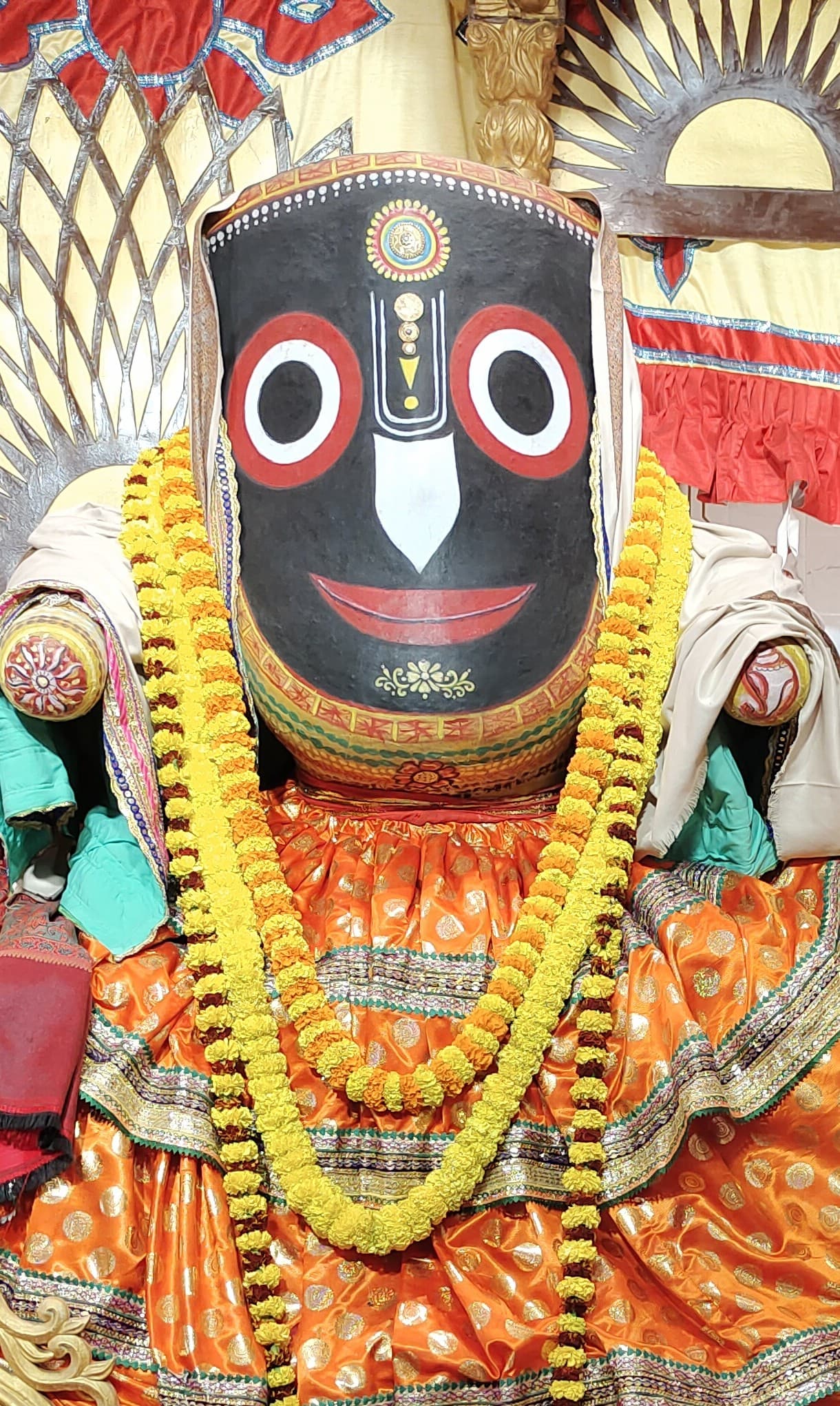
"The Lord of the Universe"
The Master of
All Worlds
Jagannath — a Sanskrit union of Jagat (Universe) and Nath (Master).
While Puri holds the title of the oldest cult, Mahesh stands as the oldest Jagannath temple in West Bengal, preserving original traditions since 1396 AD.
Compassion
Infinite mercy extending to all beings, embracing the devout and the destitute alike.
Liberation
A spiritual journey guiding souls from the cycle of birth towards eternal moksha.
Prosperity
Bestowing spiritual and material well-being upon those who seek with a pure heart.
Universal Love
Transcending all boundaries of caste and creed, uniting humanity in divine love.
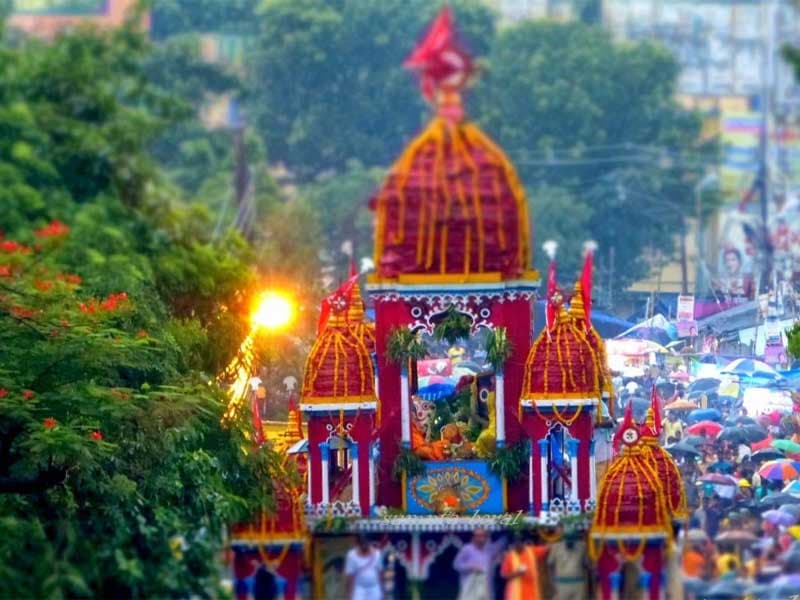
The Nabaratna Rath
Constructed in 1885 by Martin Burn Company
The Chariot of
The Sky
The Mahesh Rath Yatra is a spectacular legacy drawing thousands. It has a rich history of evolution:
- Origin
A devotee from Baidyabati donated the first Ratha to the temple.
- 1797
Sri Ramakrishna’s famous disciple Balarama Basu’s grandfather, Krishnaram Basu, donated the second Ratha.
- 1835
His son, Guruprasad Basu, renewed the chariot.
- 1885
The current iron masterpiece was ordered by Dewan Krishnachandra Basu from the Martin Burn Company.
Constructed at a cost of approx twenty thousand rupees at that time, this Ratha is still in existence today. It features a steel framework with wooden scaffolding and acts as a mobile Nabaratna temple with nine shikharas.
50 Feet
125 Tonnes
12 Iron
12-inch circumference
Nabaratna
Four Storied
2 Copper
Blue & White
2 Swans
Front Attached
"Driven by two 100-yard Manila ropes (10-inch circumference). Bronze bells announce the journey, and antique guns fire to halt it."
Chariot Procession
The divine chariot carries the holy trinity through the sacred route, blessing all devotees who witness it.
Spiritual Significance
The represents the journey of the soul towards spiritual liberation and ultimate truth.
Community Gathering
Devotees from all walks of life unite in celebration, strengthening the bonds of the spiritual community.
Sacred Rituals
Special pujas and rituals are performed to invoke the blessings of the divine trinity for prosperity.
Our Values & Community
At Mahesh Jagannath Temple, we believe in fostering a welcoming community where all devotees are respected and valued. Our core values guide every aspect of our temple's operations and interactions.
Spiritual Growth
A nurturing environment for meditation, ancient rituals, and deep teachings.
Community Service
Active charity programs reflecting our commitment to the welfare of all beings.
Radical Inclusivity
All are welcome regardless of caste, creed, or background to experience the divine.
Preserving Tradition
Meticulously celebrating ancient rituals to bridge the past with future generations.
Sacred Geography
Mahesh Jagannath Temple
Mahesh, Serampore, Hooghly
West Bengal 712201, India
Nestled in the heart of Serampore, the temple offers an oasis of silence on the banks of the Bhagirathi, connecting the bustle of the city with the serenity of the soul.
Arrival Guide
Multiple ways to reach the holy sanctuary
By Train
Serampore Railway Station (Well-connected)
By Road
Via NH12 / GT Road (Regular bus services)
By Air
Kolkata Airport (CCU) ~ 40 km away